
NYC wanderings
Back home

After a long string of residencies, I have enjoyed being at home — in Brooklyn, and also literally on my couch. Going away is good for meditative thinking and creative work, and it abstracts everything in a way that makes a return fresh, interesting, and slightly destabilizing.
When I was away, many people told me they were sure I would hate The Drama as much as they did. But when I caught it just before it left theatres, I had one of my most delightful film experiences in a while and was perplexed by my circle’s general dismissal of it. It’s the story of a person who is scapegoated for not committing an act of violence — she intensely fantasized doing it — by people, the movie makes clear, who actually have hurt others in cruel ways. The ingenious set-up allowed a perceptive comedy of hypocrisy and projection to unfold. This director, Kristoffer Borgli, is special — Dream Scenario and Sick of Myself are also excellent, idiosyncratic dark comedies about victimization and scapegoating that are linked thematically and formally but distinct.
For me to really like a work of art or entertainment, I need to feel that it understands something about life that for whatever reason is not understood or is under-discussed. The first two seasons of The Comeback had this quality for me. Lisa Kudrow played sitcom actress Valerie Cherish as a deranged narcissist who, while not being a bad person, simply cannot accept the ways she is not central to the world she inhabits. One great bit from (I believe) the pilot has her ignoring her beloved hair stylist’s cancer diagnosis because she’s so wrapped up in herself. It’s funny, sad, recognizable — and you barely have time to process it before the next narcissistic micro-moment arrives. It’s a common dynamic with narcissists, and one not much talked about.
Season two deepened and darkened the character of Valerie, I felt, so I was excited for season three. But season three did the opposite: instead of exploring the not-understood or under-discussed, it existed to (barely) dramatize the thesis that AI is dehumanizing and a threat to the entertainment industry. The character of Valerie was still slightly narcissistic but essentially she had overcome the extremes of her narcissism and was a voice of wisdom about Hollywood, technology, humanity, etc. This need to demonstrate a banal thesis at every turn robbed the show of what had made it challenging and unsettling. To sentimentalize is always to flatten.
I wrote about Alex Stupak in one of my first Substacks. I enjoy having role models in industries outside my own, and he has been a big one for me — someone who thinks deeply and critically, wants to both challenge and provide pleasure, and who grasps economic and business realities without sidelining his artistry. So when he showed up on a mainstream Food Network competition show, I took notice. (Interestingly, the only other chef I can say is a role model for me, Wylie Dufresne, just did a full season on a cooking show as a judge.)
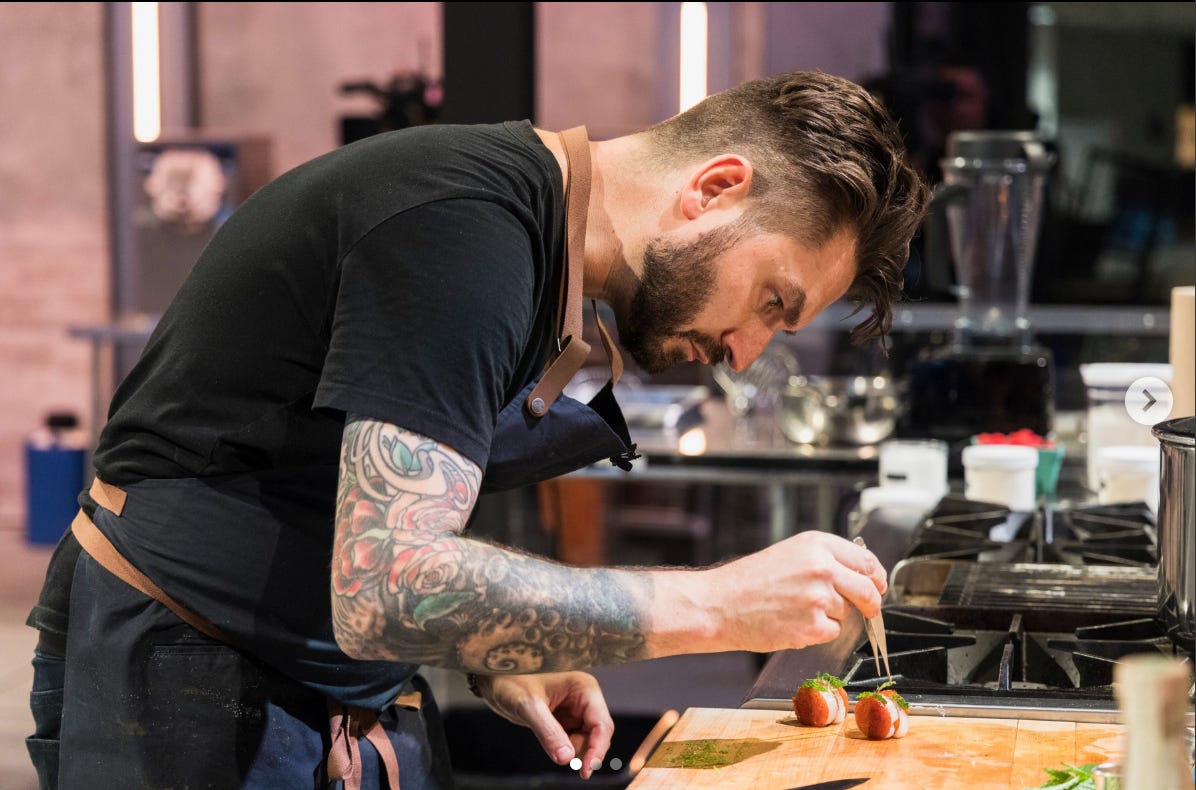
Alex was able to translate who he is (or who I understand him to be) to television remarkably well. In fact, he was so himself that multiple Redditors took to the Food Network subreddit (yes I read it) to slam his supposedly arrogant personality. What they were really seeing was a creative, assertive, libidinally alive spirit who is not constantly manipulating our perception of him to fit the mores and psychological trends of the day. He simply is who he is. To know him even casually as I do is to understand him to be sensitive and kind, but the “Food Network superego” surely favors more happy-talk, neutered, and sentimental personalities.
If there were a “Theatre Network” competition show calling on playwrights to compete, I have to say that Alex has shown me a route to do it without compromising creativity or integrity. Granted, there is no such channel and there will never be one.
Fifteen years after eating his desserts at wd~50, I am still surprised and delighted by Alex. He shows me it’s possible to be yourself in a deeply trivial era.
Finally, earlier this month, I had a fun chat with Raanan Hershberg about one of my favorite movies, Stanley Kubrick’s Eyes Wide Shut. This is my third appearance on his show. I’m getting better at being on podcasts. I tend to hate podcasts — people talking, talking, talking, endlessly, all the time, sucking up cultural energy that I suspect once went to art — but I think we got into some interesting ideas about this masterpiece.